
My father was an aircraft mechanic in the Navy during World War II. He worked on a Martin PBM-552 "Mariner" out of Banana River
Naval Air Station in Cocoa, Florida. Part of his
personal myth was that he was drafted out of his high school classroom the day
after he turned 18, and he didn't finish high school until he returned from his service. I don't actually believe this because he
didn't report for duty until the July after he would have graduated. That information is on his discharge papers. It's probably partially true though. The Navy rep probably showed up at
school to draft him after he turned 18 but they let him finish high
school. He wasn't sent to an active combat area because both his brothers were already at the front. In case you are wondering, the Air Force as a separate branch of the military wasn't established until 1947. After the war. His other story from his time as
a mechanic was, the navy didn't allow the plane he worked on to fly without
him riding along. This could be
true. It seems like a pretty good way to insure an 18 year old mechanic learns
his job fast and well. My father was a
really good mechanic although he used the GI bill to go to college so he didn't
have to spend his life fixing engines.
Except that he did. My father
only ever had one tool box. It weighed
approximately 182.3 lbs. Every tool he
ever owned was tossed into that tool box.
In retrospect, I think the most stunning thing about my father's tools
was that he didn't have a single screw driver that wasn't stripped. I
don't know how he used them, but he did.
His tool box was chaos and it weighed more than an average human, but if
your car broke down and you called him, he would "toss" the tool box
in his car, go to you, and using those
useless screw drivers have your engine humming in no time. Because of my father, I spent decades with an old pair of stockings
in my glove box. I don't know if that's still a
thing. My father isn't around anymore so
I use AAA. Anyway, even though his tools
appeared to be a crazy mess to almost anyone who ever saw his tool box, he
understood it. He knew exactly what he
had and how to use it. It was his system
and it worked for him.
 |
| This is the plane my father worked on. Not this one but this model. |
My grandmother, on the other hand, was a musician and urban
farmer. She was strictly a musician until World War II when she was asked by her country to plant a victory garden. So she did.
Then she was a musician and an urban farmer. I think she dedicated herself to learning how to grow food in the same
way she had dedicated herself to learning to play music. She also took care of her tools with the same
care she used on her instruments. By the
time I came along, well after the end of the war, my grandmother was growing
food on an acre of land in the middle of Denver. She grew enough food to feed the whole family
and each fall was filled with the sound of canning jars popping. I didn't really taste "store
bought" vegetables until I went off to college. My grandmother had some wonderful
quirks. One of them was that if she sent
my father and me out to pick peas in the spring she didn't expect to get any
back. We just ate them as we
picked. The same went for sending me out
to pick strawberries in the summer. She'd
send me out with a bowl to gather strawberries to make dessert for supper, and
I would return with a bowl with one strawberry in it and my hands and face
covered in strawberry juice. My grandmother would eat the strawberry and then
we would make chewy bread, which was my grandmother's version of brownies, for
dessert instead. I now believe sending me out to pick anything was just a ploy to get me out of her hair, but if you have never tasted spring peas
fresh off the vine or little jewel type strawberries ripe and warm in the sun,
you should definitely put those things on your bucket list. Those are the food pleasures that no artisanal
cafe can even touch. Anyway, my
grandmother was fastidious with her tools and her musical instruments. Each tool had a place so that she knew
exactly where it was and after it was used but before it was put away, it was
cleaned. And just as my father's system
worked for him, hers worked for her.
 |
| This is a Martin flat back mandolin. My grandmother had one of these and it's what she played most of the time. She was apparently an exceptional violinist until she met my grandfather who was an exceptionally bad driver. The family story is that he had a head on collision with a truck while trying to pass a street car while driving his motorcycle with my grandmother in the side car. He had no injuries which was how it always went for him, but my grandmother was thrown over a wall and ended up with a broken arm that was set in a way that meant she could never play the violin again. Good musicians meets bad driver. So she played the mandolin, opened a music school, and learned to grow things. |
I live somewhere in the middle of these two extremes, but my
point is that you need to find your own relationship with your tools. Once you are comfortable with your tools you
will do good work. This is probably why
I keep repeating that I am not a purist.
The work that I do is more important than the specifics of the tools that I do it
with. So as I move forward talking about
tools and setting up a shop, keep yourself focused on what you want to do. There are a lot of means to each end and you
need to find the one that works for you.
If you are following along with me and building your shop,
you now have a massive and sublimely beautiful work table and a stock
rack. Plus a couple of metalworking tools. You also have less money than you had before
and you met your steel yard supply guys. I really love all my steel guys and I
told you last time not to fear them.
They are the best. The last
delivery I got was a week or so ago and it's been really hot here so the steel
is really hot on the truck. I have some
beat up work gloves so I put one on to go unload the truck. The driver just couldn't deal so he reached
into the cab and gave me a new pair of work gloves. He didn't want me to hurt myself. As he was about to leave he handed me a
second pair because he figured I would
lose the first pair like he does. These
guys are always so great.
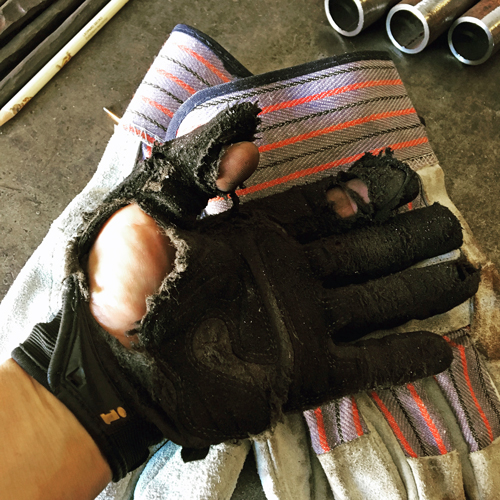 | |
| The work glove I put on to unload the 115 degree steel and the gloves my driver gave me. |
You've also started to think about what you need to do the
kind of work you want to do and what would make it easier. At this point you can go in a number of
directions. If your goal is to do
primarily fabrication type work, you can slowly acquire tools that make that
easier. A better way to cut steel. I use a 7x12 metal cutting band saw. A lot of people chose to use a cut off
saw. The cut off saw is cheaper but I
don't really love the fiber glass particles that it propels into the air. The "dust" from grinding or cutting
with a fiber glass disc does two things.
The metal dust falls to the floor because it's heavy, but the fiber glass particles fly around forever
because they are light. You really don't
want those suckers in your lungs. For me
the extra expense of the band saw is worth it.
 |
| This band saw is pretty close to mine. I don't know what all the little plugs on the lower left are, but the rest is basically the same. There are smaller band saws, and you can buy a portable band saw and a frame to convert it. Harbor Freight has one too. I don't know how the Harbor Freight saw works. I had a smaller band saw and the problem with those is that the blade is small so it skates. That means your cuts are not square. If you are only cutting small stock a smaller band saw is fine or even a large shear. If you are going to cut larger stock this band saw is a versatile choice. Band saws are slower cutters so if you are doing production work you probably want a cold saw. I think of that as a larger shop tool so I'm not going to go into it. They are pricey but a really sweet way to cut steel. But they are pricey. |
 |
| This is a chop saw. The fiber glass disc wears away as you cut. It also spews fiber glass all over your shop. As I said, the fiber glass dust floats. This cuts pretty fast, but it's really loud. Wear lung and ear protection unless you don't want to be able to hear during your short life. These are relatively cheap and worth every penny. A lot of fab shops use them. I really don't like them as you can probably tell. |
You should also get a drill press. I
got mine at an auction and if that is possible, it's a great way to get
tools. You need to pay attention to the
chuck size on any drill press you are looking at. A 3/8" chuck will drive you insane in a
pretty short period of time. Get at
least a 1/2". It will be tricky on
teeny holes but much better the rest of the time. Also, I prefer a floor model.
 |
| This beauty is exactly my drill press. It's all cast iron. It's really old, but it works. I should probably replace the chuck. |
 |
| I don't really know about the new drill presses, but this one looks pretty nice. You are going to need to do some research on this. |
The last really basic tool is a disc and/or
belt grinder. I have a couple of
these. If you are going to make knives,
you will need to do some research to find the best grinders for that. I like the one I have. It has a quick change unit and mounts on a bench grinder so I can change
the belts in a couple of seconds. This
is good if you are making knives, but even if you aren't making knives work
will be easier with a disc or belt grinder or both.
There are so many of these and this is a really personal decision. Figure out what you are going to do with it
and pick the grinder that does that.
 |
| This is a basic bench disc grinder. I would get a 12" dia. It's a pretty useful tool. |
 |
| This is the quick change belt grinder I have. It's a Multitool attachment kit. You attach it to your bench grinder. The belt is really easy to change so you can go from roughing to polishing very easily. I'm sure it's not good enough if you are making knives professionally, but it works for my needs. |
I have a lot of other tools because I do a lot of different
types of metalwork. Some I got because
they were there and it seemed like a good idea.
This is why I have four anvils.
Nobody needs four anvils. I also
have a lathe. I use it all the time. I got by before I had it, but a guy was
getting rid of it and I couldn't pass it up.
I'm happy I have it. I had a
little milling machine for a while. It
was too small so I traded it for something.
I don't actually remember what now. I
know it wasn't money. I have a Hossfeld
bender. I used to use it more than I do
now. I have a shear. I have a compressor. Most tools after the basics are purchased or
made for a specific job. Then they
become part of your arsenal. You can do
more because you have the tool to do more.
 |
| This is a Hossfeld bender. It is designed to bend steel cold. It has a number of dies so you can bend different steel shapes into different steel shapes. It's a pretty amazing tools actually. |
There are a lot of ways to work with metal. Each practice has its own set of tools. Of course there is overlap. As we go forward, I'm
going to talk about the thing that I think most people are interested in first
and then move on to some tools and techniques that I think are interesting too. Next month I will begin to go into the tools necessary
for blacksmithing which includes bladesmithing tools. As I talk about tools I will also start to
introduce techniques.
I hope you will practice your welding so that you are comfortable with that and are ready to
use a hammer. In the meantime make a feed table for your saw. Make some horses. Make a feed stand for long pieces on your disc grinder and drill press. There are a lot of pieces of shop equipment that you will need and need to make for yourself. This is the month for that. Enjoy the learning process.
 |
| Such a fancy feed table. Mine is so crude compared to this, but it works. This is just an idea. It doesn't need to be this fancy. It doesn't need these rollers. You can make rollers with solid bar and pipe. It doesn't need to be height adjustable, but that is nice. Take this opportunity to design what works for you. |
 |
| You can buy this stand cheap at Harbor Freight. They fall over. They are too light. Design a better version for yourself and make it. |
 |
| This is a horse. It is not the horse you need to make for your shop, but it is a pretty cool horse. |
Back to the heat...
Go have fun.
j


